Showing posts with label Mindy's Misadventures. Show all posts

Tuesday, January 24, 2017

Two Out of Three

I have never been raped.

I am fortunate. I have been supported by friends and family who allowed me to feel strong and taught me to stand up for myself.  My loved ones have always contributed to my feeling of security and importance in this world.  I am privileged.

I have never been raped.  And still I have been made to feel small, weak, and undervalued.

As a middle schooler, I was followed home by a boy who was bigger and stronger than me. I told him to stop.  The next day, he left before me and jumped out of some bushes a block away from my house.  He wanted to scare me for a joke.  I laughed because I was scared and I didn't know what to do. 

I have never been raped.

As an adolescent, my male friends referred to my stylish braids as "handle bars."  Again, I laughed.  I felt uncomfortable.

Those same friends of mine once worked together to attempt to unbuckle my overalls because they learned doing so would cause them to fall down exposing me in my underwear.  When I protested, the 2 of them pushed me forcefully into the nearby boys bathroom.  I was backed into a stall, and yelled furiously as they laughed and unbuckled my straps.  They then ran away, leaving me alone, in the boys bathroom, in my underwear.  I did not laugh.  I was astonished.

I have never been raped.

In college, I once had to forcefully shove my elbow into the padded belly of a man dressed as a tomato who felt that the dance floor of a Halloween party was an appropriate time to slither his hand up my shirt and cup my boob.  I did not know him.  I could not see his face, but I stomped his foot, elbowed his gut and shouted "FUCK YOU TOMATO!" I laugh about this now.

I have never been raped.

In my 20s, when I went out dancing with my friends, we regularly discussed how we would skillfully dance one another away from the unwanted advances of men who felt our enjoyment of music was an appropriate time to touch, fondle or kiss us. I remember spinning a friend away from a man who randomly stuck his tongue down her ear.  With my back to him, on a crowded dance floor before we could get away, he grabbed my breast.

I have never been raped.

However, I once purchased a couch from a man who copied my phone number off the sales record.  He began texting me.  At first I responded, thinking of the possibilities.  The messages quickly became uncomfortable, and I stopped responding.  He showed up at my apartment a few days later. I hid from him in the elevator. 

I have never been raped.

However I have been hit on by men who had wrong numbers and knew nothing about me other than that I sounded female. I once answered the phone at a clinic for survivors of domestic violence and encountered a man seeking treatment for batterers. After I directed him to the appropriate agency, he asked for my number. 

I have never been raped, but I have clutched my keys in my hand while trying to find my car in a dark parking lot.  I have held my phone tightly in my pocket while riding public transit alone in the dark.  I have asked to be escorted to my car in the secure parking garage of my luxury apartments. 

I have never been raped.  Though some of what I have experienced constitutes sexual assault, I have never been attacked or beaten, and my experiences do not count in the eyes of statistics. Many of my experiences were brief, and easily escaped. Those that weren't, were reported and promptly dealt with before they could escalate.  I have been protected, defended, and able to keep my self "safe."

I am one of the lucky ones, and these are facts from my life.

I have never been raped. At least not yet.

Saturday, October 17, 2015

Evolution of Imagination

"Um..could we go for a stroll?"  A delayed adolescent boy asked me one day.   Of course I agreed, and as we walked he asked, “do you like imagination games?” 

I replied with a resounding, “I LOVE imagination games!”

“Would you like to play my imagination game?”

If you’ve read my blog before (which you might not have because it’s been literally forever since I’ve met you all here) this probably sounds like the beginning of my perfect afternoon. Time spent outside, with a kiddo, playing an imagination game, and exploring the themes he develops and works through.  Um…yes please!

Unfortunately, this didn’t go the way I expected.  The young teen walked me down to the football field, and proceeded to tell me the rules to “the game I play in my head.”   The game was called “Clash of Clans,” and if you’re thinking that this is a game that already exists in tableland.  You’re right where I am.  Open-minded and optimistic, but confused.

***For the reader’s information - As I understand it, Clash of Clans is the new equivalent to a point and click adventure.  While there is a back story and one or more goals, the overall action of the game is to “tap” on different parts of the map in order to collect whatever it is they are collecting.  In order to play it, you basically sit and watch the game play itself until it has produced something you can “tap” on. Get it?  Cool.  On with the story!

Kiddo explains to me that we need to build the town barracks, fortress, or some unspecified medieval edifice.

“So,” he says, “first we need to collect wood by chopping down those trees!”  He points toward the northwest corner of our line of sight, at about 50 degrees from midline.

“Great!” I energetically declare, as I grip my make believe axe and start to swing.

“No, no!” he reprimands, as though I’m missing the obvious.  “You just tap here and slide it.” Kiddo then proceeds to “select” the same area he indicated prior, and slides it horizontally on the same plane.  This is when I realize that the game he plays in his head is just that.  It is a literal game, that he is playing in his head. What happens next involves me essentially gaping at him as he seems to project an invisible giant tablet into the foreground of his line of sight, and continues to “tap” and “select” unforeseen areas of the map in order to achieve some inexplicable goals. 

He narrates the whole thing for me.  At times he asks for me to take on a task.  He gets annoyed that I attempt to act it out and explains to me, again as if I were an idiot, that I simply need to tap the thing in the air I cannot see. In theory, I should be tracking it.  It’s not all that complex.  Instead, I notice my heart sinking. I feel helpless. I become slightly annoyed with this game that “we” are playing.  Suddenly, I start looking around for excuses to interrupt the game.  I grapple with the tension between improving our relationship by allowing him to play, or impeding our relationship by sitting with him for a full hour, irritated with our activity.  Eventually I claimed a mixture of “it’s too bright outside for my eyes” (a lame but true fact for those of us with blepharitis and no sunglasses) and “I think you should get back to class so you don’t miss anything.”

Over the next several weeks I struggled with this memory.  I love the unexpected and imaginative things that kids do in their minds.  It is my favorite when they invite me to witness it.  I should find this delightful!  So, why did I find it so off-putting?

It wasn’t until recently that I put it all together.  I was sitting with a different delayed pre-adolescent.  I was observing him to use jenga blocks to create an entire world.  In front of me evolved what looked like a cityscape.  The same wooden blocks were used as mortar and as character.  Blocks spoke to one another, while more blocks constructed skyscapes around them.  I was, to say the least, captivated.  This was incredible.  This kiddo was using his imagination to work out issues.  The conversation between his humanoid blocks was rather unintelligible.  I have no idea if they were discussing world piece, impact of trauma on world view, or just what ice cream they both like, but it doesn’t matter.  This kid was practicing some very useful skills. Whether or not he was aware of it, he was testing the limits of reality, by using his imagination to play out some dynamic scenario. 

This is play with a purpose.  It is how we learn about ourselves and the world, and it’s crucial.  Many species do this.  All you need to do is turn on national geographic, and you are eventually bound to see some video of a polar bear, a lion cub, or tiger pup using play to practice very necessary survival skills.

That’s the difference.  The mind tablet lacked utility.  Kiddo was not using play in the way it was developmentally intended.  He was not practicing social skills.  There were no social skills being used. The game was entirely one sided.  Even when I participated, I had no idea what was going on, and he typically ended up taking over for me.  He wasn’t working through survival skills.  The clashing clans were warring with one another and protecting their territory, but Kiddo just “watched” and then “tapped” when it was over.  The only thing I can see him learning from this process is patience.  The work was definitely not hard, and the topics were flagrantly simple. 

My sadness and irritation then comes to the question of why?  Play exists to help us learn, and kids are incredibly adaptive.  Which, means that this kiddo has got to be working through something, and I don’t understand it.  This leaves me wondering if I have reached that very depressing aspect of adulthood when I no longer understand “kids these days.” Or worse, is this the work of modern children?  Is it becoming a 2-dimensional and nonreciprocal world of “sit and wait,” or “tap and slide”? How painfully sad would it be if children physically reenacting stories turned instead into watching flat projections that no one can see and engage them with? Is our thinking becoming more and more 2-dimensional? Or have I lost my ability to connect?

Monday, March 10, 2014

Commitment Issues

Image found here
Let me first start by apologizing for my prolonged and unexplained absence.  I had an unexpected change to my work schedule that resulted in a lot of late appointments and difficulties rearranging my day to day needs. 

This came at a bad time in terms of my writing progress.  I was feeling like I just finally got back in the swing of things.  My recent blogs were sounding and feeling less forced than they had been.  Then, bam! Change of schedule.  My routine broke up, and now I'm out of practice again.

To be totally honest, this frustrates me.  Just a few years ago I found myself to be frustrated with my blogging peers for their own intermittent commitment to their "passion."  At the time, I was following multiple internet authors, and gaining information about the process of running a blog.  I found that I enjoyed the predictability of regularly scheduled blogs, and the writing quality seemed to improve with blogs that posted frequently.  So, when the posters I followed began to slowly trickle off the internet I declared confidently to myself: "I will never do that."

Certain I could sustain such a problem, I trudged forward with a goal of weekly posting.  Thus began Monday Musings.  And, I was fairly successful with it.  For over a year I faithfully published a post every Monday.  Then came my graduate thesis and my internship, and a hiatus seemed in order.  It was with great displeasure that I announced my break from Leaving Neverland to finalize my academic pursuits.  The plan was always to resume weekly blogs once I earned my degree.  However, I'm clearly not holding strong to that plan.  My epic writers block and jam-packed schedule have made blogging and book-writing take a back seat, and I hate how this looks.  It would seem like I no longer care about this endeavor, and the truth is far from that. 

So, I'm understandably dissappointed.  The problem is, I just don't know how to move forward.  I'm suffering from a strong case of writer's block; going on 6 months now.  The only thing I can think of is to implore my readership for ideas. I'd like to resume weekly blogs, but clearly I need a storage of ideas and topics.  Either that, or I need to readjust my schedule.  Which is where I look to you all.  What are your thoughts?

Monday, February 17, 2014

Automatic Answer Syndrome

Image found here
When I was little(r), I was somewhat of a know it all.  If I was comfortable, I could be quite the chatter box.  Any question pointed in my direction likely got a lengthy monologue in response. Sure, I was pretty cute, but even the cutest of little ones can exhaust the attention of those that love them.

After seemingly endless periods of squeaking my every thought and observation, I eventually encountered the much too advanced wisdom of my father.  I recall conversations in which he spoke at my wee tow-head about the concept of noise pollution.  Believing himself to be helpful, he explained that my excessive verbalization was just adding needless sound to the world.  He guided me through picturing what the air would look like if we could see sound, and insinuated that I was soiling breathable space with my desire to talk without purpose.

This was not as awful as it sounds.  Though my not yet fully formed brain was momentarily stifled by the all too scientific advice of my apparently heroic father, I didn't actually stop talking.  It's possible that I may have slowed down some in response, but historic reports of my family members would indicate the inaccuracy of this assumption. On and on and on I prattled; selfishly soaking up the sound space around my loved ones.

In particular, I loved to prove my intelligence to my father.  As you may have discerned from the above story, my dad was pretty clever himself.  I'm pretty sure that was always obvious to me.  I even imagine myself as an infant, craning in his arms, thinking "whoa! this dude is smart!" So, naturally I had to rise to the genetic occasion. As a bumbling tot trying to form my own understanding of the world, I assumed I had to prove my worth by immediately answering every question that even seemed meant for me.

Obviously, I got a lot of questions wrong.  That's what happens when you increase the frequency of your attempts at anything, you increase the chances for error.  Eventually, as it always did in my family, my behavior led to another paternal teaching moment.  I recall a family dinner, with us all seated at the table discussing our days, and likely answering trivia questions to the key of "for an extra two points!"  I must have exhausted the patience of others with my interrupting and attempting to guess at things I didn't truly know, because my father finally spoke out against it.

"You don't always have to know the answer," he calmly stated.  "There's nothing wrong with saying you don't know."  He then guided us through acknowledging our ignorance, and confidently stating "I don't know."  From then on, both my parents would pause us when we demonstrated notable sensitivity to the unknown, and guide us through calling ourselves out.  We were repeatedly coached to practice alerting others to our dearth of knowledge.

I found this activity irritating for the vast majority of my childhood.  I hated telling people I didn't understand them.  I abhorred acknowledgement of my inadequacies in a public forum, and I resisted encouragement to lay it all out on the table.  Only recently have I realized that this ongoing tutelage actually took.

In my adulthood, my academic and professional careers have been marked by my insistent confession of inadequacies.  It is possible that I call out my lack of wisdom all too often.  However, I'm frequently praised by superiors for indicating that I have yet to glean what I need to.  Personally, I often attribute it to my sense of innocence and inexperience with all things "real world."  Though, I have started to notice my own frustration with colleagues and superiors who lack the strength required to assert their ignorance. I find myself often grunting vexation with "knowledgeable others" who automatically throw out suggestions unrelated to the questions I have asked.  My head spins with annoyance when I turn to seasoned professionals who attempt to guide me through basic responses to situations I am comfortable with, and ignore my pointed questions about how to deal with advanced complexities.

My initial assumption was that this played on my own inadequacies.  My primary response was to think "they must really think I'm stupid if think I've forgotten the basics," but then I realized it wasn't this at all.  Due to my own prior experience with automatic answer syndrome, I quickly understood that the truth was they don't have the answers either.  It is they who lacks the knowledge to further themselves. Because they never had support to build comfort with their own lack of understanding, they have habituated time-wasting discussions of things that don't matter.  They don't understand the utility of recognizing a deficit in order to build upon it.

Monday, February 10, 2014

My Hats: The Asshole

Today, I am an asshole.  I am the bearer of bad news.  I am the nay-sayer, and the barrier to fulfilled wishes.

Image found here
This is the nature of my work.  I am so many things to so many different people, and generally that is okay.  For the most part, I'm able to acknowledge my varying head wear and done it accordingly. In fact, the variety serves as a protective force for me.  In one day I can be a savior, an attachment figure, an authority figure, and a friend.

The peculiar paradox is the difficulty inherent in the days marked by consistency.  Today was one of those days. I got to wear one hat today. I wore it all day long, and that took a toll on me.  It's hard to wear the bad guy hat for a sufficient length of time and not internalize it.  Eventually, it wears on you.

While I know that I am not truly a bad guy, and I understand that I am far from being an asshole, it's how I feel today.

Monday, January 20, 2014

Self Discovery

About two weeks ago I came home from work at my normal time, flopped on the couch, and declared epic fatigue.


"I'm tired!" I whined, perplexed that this normal every day experience had resulted in complete and total lethargy.  Being someone who must understand everything, I felt rising irritation at the irrationality of my listlessness.  There seemed to be no reason for me to feel this out of sorts.  Yet there I lay, trying to stave off the inner toddler rising to tantrum within me.

Then I did as I always do, I gave in.  This is a piece of wisdom I gleaned from many years of facilitating and safe-guarding the worst hissy fits imaginable.  I now know, after endlessly trying to circumvent hysterical meltdowns, that it's pointless.  One way or another, the emotion is going to catch up with you.  I learned to just prepare myself and others for the experience, because that's the only way to learn from it.

So, melt down I did.  In my own modified adult way, I let the child within me loose.  I cried for a minute or two, whimpering about how profoundly busy I felt.  I bellyached about my active lifestyle and how I knew it was irrational for me to actually miss my couch. I tossed and turned, and catastrophized that I hadn't had a moment to myself in years.

As I started to pull my act together, I began to actually listen to my petulant rant, and the logical part of my brain made the connections.  I'm an introspective type.  Regular readers may have noticed that my thought process often follows an inward train. My own self-exploration comes from down time and zoning out while "doing nothing." For this reason, it is crucial that I provide myself with regular relaxation time.  I need to sit in a comfortable space and allow myself to get lost in my own musings.  When I don't, I lose myself.  Though highly motivated, I forget who I am in my endless drive to the next step.

Thinking this through, I began to realize that my catastrophic thinking wasn't entirely unrealistic. In fact, I'd spent approximately the last 2.5 years working a variety of jobs, moving, attending graduate school, moving again, doing a high stress internship, volunteering, researching and composing a painstaking thesis, and beginning a career. All the while haphazardly making some of the best, most life altering, decisions ever.

 In my last couple of years, I forgot the meaning of transition.  I jumped from one thing to the next without even taking a beat.  In most cases, one thing overlapped with the next for quite some time.  I had forgotten to pause, and I definitely didn't stop to think.

So, yeah, I was tired.


Monday, January 13, 2014

Braggart Reform

Image found here
When I was younger I could be quite the know-it-all.  Teachers liked me, because I sat quietly in class, raised my hand, and answered the questions I  was asked. At home, I would jabber on and on about all the things I learned in school.  I would talk my parents' ears off as I described every accolade and academic triumph of the day.  I'd chatter away bragging about all of my skills and scholastic strengths until my dad would sigh with exasperation and declare,


"If you're really smart, you won't have to tell anyone."

As a small child this advice baffled me.  Of course I have to tell people, I thought to myself, how else will they know?  I truly believed that I had to prove my worth to others.  Because of this, I took my father's advice how I always did.  I ignored it.

I went on striving for perfection and asserting my value to all who mattered to me.  All the while, my father repeated his advice  every time he was subjected to my self-aggrandizing daily reports.  I'd roll my eyes, stomp my feet, and complain that I was merely trying to describe my day.

I never thought this advice effected me much, except to confirm that my dad could be rather insensitive.  However, as with all mild irritations that are set on repeat, I slowly internalized his words.  Without realizing it, I took on his meaning.  Before I realized it, I grew into a strong young woman who speaks to others in simple words while resisting the need to prove my intelligence.  I now equate my wisdom and skill with that of most people.  I recognize my competencies, but I see myself as no better or worse than any other person just with a different set of privileges.

Monday, December 9, 2013

(Not) Helping

I work a 9-5 now. I got home at 6:45pm today. I could have stayed later. I should have stayed later.

This is the nature of my work. I'm currently operating at a half a caseload, and the amount of action items and steps to take on is overwhelming.  It's never ending. There's always someone to talk to, and something to do. There's always someone who wants something and someone else who needs something from me. I'm quickly learning that my job involves a massive amount of identifying who and what does not get my attention.

I took this job because I like spending time with children.  I'm energized by working with kids in need, and I have a knack for intervening in a crisis.  I took this job because I want to help, but what I'm quickly learning is sometimes not doing something is the only help I can provide.

Wednesday, December 4, 2013

What I Am

I spend a lot of time thinking about what I represent to others, and I recognize that it's a lot of things.

Image Found Here
For some people I represent The Answer. I am the authority that holds the knowledge that gives insight.  For other people I am The Power. I hold the keys to the doors that get you toward what you need and away from what you hate. They do not see me. Their thoughts tell them all they need to know.

Some people believe I am The Innocent.  I am a youthful representation of freedom and ignorance. When some see my size, stature, and appearance, they assume I am without wisdom, skills, or know-how. They don't hear me. Their perception tells them who I am.

There are those who see me as The Maternal. I am The Savior. I am The Nurturer. I am the person who holds people when they cry. I am the one who makes everything all better. Then I am the one who flees when there's a need. I am The Abandoner. I am The Perfect Bitch. I am the Spoiled Child. I am The Privileged One. There are those who believe I represent everything they are not or cannot have. I am a reminder of pain and misfortune. They have no sense of me. Their history and experience forms their impression of me.

There are also those in my life who clearly see me as The Hope. I have been inexplicably called The Favorite in a variety of realms. I represent Something That Could Be. I have the skills or the prowess to turn things around, to enact change, to make things better. These people hear me selectively. I cannot ask them for help, because they do not perceive me to need it.

There are others who perceive me as The Needy. The Distant. The Reactive. The Disengaged. The Nosey; Over-involved.

I am a variety of things to a wider variety of people. I am The Projected. The Absent. The Superimposed.  I spend the vast majority of my day, my week, and my life filling the role I am assumed to have given the situation, relationship, and context. I represent what I am to individuals, groups, and systems. I try my best to work with this, but it is so moment to moment, that much of my life I find myself assessing what I am in each specific scenario, and I forget to ask myself what I truly represent.

Representing so much to so many, leaves me forgetting who I actually am. What is my role to me? What do I want to be? Who am I to me? Who even knows?

Monday, November 11, 2013

Identity Solutions

Image found here
Writing has been hard for me lately.  Sitting in front of my computer on Monday nights has turned in to pulling teeth.  I essentially have to isolate myself, and limit distractions in order to get anything out.  Even then, it's difficult to focus.  About every 1.5 sentences I stop to check my phone, pick at my split ends, or play with my cat. It's become a slow going, painstaking, process, and I've been quite distressed about it.

See, I conceptualize myself as a writer.  Clicking keys to make meaningful materials has nearly always come easily to me.  Writer's block freaks me out.  It screws with my identity, and makes me question my understanding of myself and who I am.  Writing is how I process my world.  Without writing, I feel confused and unfocused.  So, naturally I've been concerned about my most recent bout of writer's block.

Last week I began to ponder my three month long impediment.  Rather than fixate on my overwhelming sense of curiosity about why I wasn't writing, I started to think about my most prolific periods, and I discovered something peculiar.  My best writing is often regarding a topic that has given me a degree of mental anguish.  Bursts of frequent essays on a variety of topics often spring up during periods of my life characterized by transition, identity crisis, and general lifetime turmoil.  I knitted my eyebrows as I processed this information; not quite sure what to do with it.  Until it occurred to me that maybe I'm not writing because I'm happy.

Monday, November 4, 2013

Next Month

Image found here
I can't wait for next month.

Lately I feel like all I do is run around.  I find myself to be jumping from one location to the next, in order to keep myself active and connected to all those I love. As a result, my life has been chaotic and disorganized.  It seems like nothing is truly getting my full attention.  All this bouncing around has me somewhat unfocused in many aspects of my life.

While this is entirely frustrating and not my typical
style, I find myself largely accepting of the situation because I know it's all temporary.  I can continue running around, because there is end in sight.

Next month, everything I need and want will come together in one place. Next month, I will be active and connected at the same time.  Next month, I will be focused and grounded.  The distance between all my destinations will be visible next month.

Monday, October 14, 2013

Feeling It Out

Image found here
I express myself more than most.  I talk about how I feel.  I get it out there.  This makes others uncomfortable.

In general, people dislike negative emotions. We see them as bad feelings that must be fixed.  When confronted with unpleasant emotions, we go to great lengths to get rid of them.  Mothers shush their babies, begging them not to cry. Teachers offer incentive plans, pleading with children to be good.  Over and over again we urge one another to turn our frowns upside down or to grin and bear it.  We rush to put band-aids on owies and wipe tears off cheeks. With the best intent, we try to replace pain with pleasantries.  In doing so, we push away bad feelings thinking they will stay where we put them.  Only they don't.

Life is full of stress.  Unfortunately, negative emotions are all around us.  We do ourselves a great disservice by avoiding upsetting feelings.  Setting aside distress momentarily alleviates anguish.  However, avoidance is negatively reinforcing.  It relieves us of stress, and deprives us of frustration tolerance skills.  The irony is that ignoring pain enhances our sensitivity to it.

In recognizing this phenomenon, I do the only thing I can do.  I acknowledge my feelings.  Initially I make no effort to fix them.  I allow myself to cry, yell, pout, or feel lost.  I recognize the sensation, and I identify the source.  Where appropriate, I express the feeling.  Often, this manifests as honest responses to inquiries about my mental state which results in bewildered expressions as others try to avoid that which I have not.


Monday, October 7, 2013

Crazy Cat, Lady

In the interest of transparency, I have nothing profound to share with you today.  I thought about trying to pull something deep out of the recesses of my mind, but to be totally honest I have more important things going on this week.  My licensing exam is coming up, and I am only on chapter 2 of 5 in the recommended study book.  So, to follow through with my commitment to weekly Monday Musings, I decided to provide you with something superficial.  The story of my cat.

Growing up I had a cat named Mallory who was essentially my best friend.  This is not to say that I was antisocial.  I had human friends.  I was just particularly bonded to ole Mallory.  So bonded, that I took her to college with me.  Unfortunately, I didn't get to see her through to the end of her life.  Halfway through my freshman year, she escaped out the front door of the apartment.  Being an indoor only cat in a brand new neighborhood many miles from home, she didn't know her way home.  We never found her.

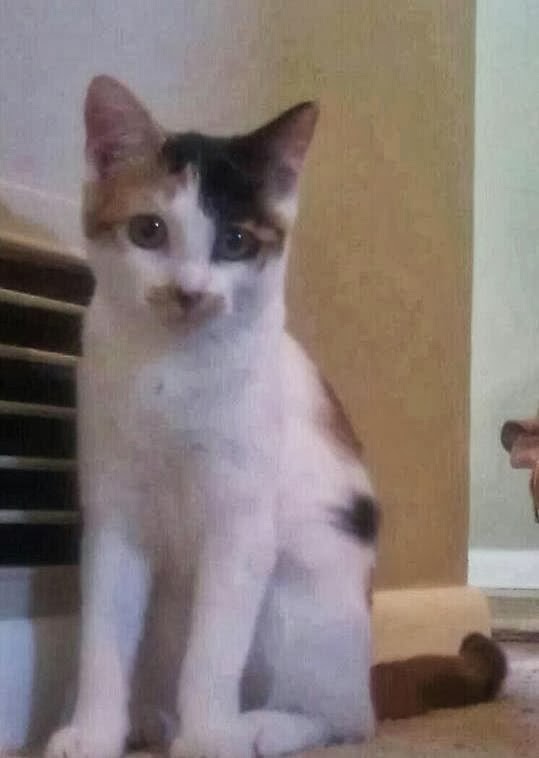
Fast forward to last year, when I was living with my sister for the summer, and a stray kitten literally wandered in our back door. It seemed almost poetic, my last cat walks out the front door, my next cat walks in the back door.  However, logistically and financially I couldn't justify keeping her. So I dubbed her Schrödinger because she seemed to exist simultaneously in two realities.  She was my cat, and not my cat. I spent the better part of two months searching for her prior home and trying to find her a new home.  We bonded during that time, and I quickly realized she hard carved out a place for herself in my world.  This is when "Dinger" became my cat.

Over the last year I learned her personality as she climbed the door frame, searched the fridge, rode my bike, and helped me study.  She was an odd little creature, but she was my odd little creature. After a few months, I expected she'd begin to settle down.  I hoped her maturing body and developing mind would eventually calm to a more regulated less rambunctious feline composure.  Only, it didn't.  She seemed to get more behavioral.  She began to defiantly climb on the kitchen table, bat jewelry off the rack, scratch walls and doors, and actually dug a whole in my carpet in an attempt to enter my bedroom.

I've been in behavioral health for quite some time, and wasn't phased by most of this.  Though I did feel at a loss for consequences when I learned that she loved being sprayed with water....  Right?! It wasn't until recently when she began urinating on my items that I thought a visit to the vet was in order.  So, this weekend we toted our little Ding-Ding to the doctor, and expressed exasperation at sleepless nights brought on by a restlessly needy kitty cat.

In an ironic twist of fate, I learned that Schrödinger's behavior fit an OCD diagnosis, and that she might respond to treatment with anxiety medications.

And that's the unremarkable story of how a crazy cat found a

Monday, September 30, 2013

Generation Adrift


Image found here
Not long ago, I found myself seated across from a loved one listening to
him lament the current state of his life.  He explained that his employment and educational prospects were not unfolding as he had wanted.  I listened attentively as he expressed anguish over feeling midway into a life that had gone awry.  Insistent that he had previously had a life agenda, he described feeling a failure at having not seen those plans come to fruition.  I hugged, validated, and soothed, as he repeated his distress without apparent purpose or intent.

At first, I didn't know how to respond.  I wanted to swoop-in with some miracle solution.  I wanted to assure him to keep his chin up.  I wanted to throw my hands up in the air and yell "you're right! This sucks! Screw it all!" Not knowing what to say, I tried to sort through my myriad of emotional responses, and I was struck with a sense of déjà vu.

It seemed as though I had heard this story before.  I recalled a call with a close friend from several weeks prior.  It was a routine check-in call, and by all outside accounts this woman's life was going very well.  Only, when you asked her she disagreed.  To her, she'd missed opportunities to follow her dreams.  She felt stuck between wanting to make her dreams happen and feeling like it was too late.  This wasn't the first time. When I considered the tone of our chats over the last few years, this was a prevalent theme. She wasn’t the only one either.

In fact, when I thought harder, I could cite a plethora of conversations in a similar vein.  I remembered tears over coffee, commiserating with cocktails, and throwing hands in the air during hikes.  It seemed that every 20-something I know carried a degree of angst regarding the apparently off-track direction their life had taken. Actually, my own life didn't stray too far from this pattern.

I continued to listen, pulling the pieces of a generation together, as he took a more dire "where did I go wrong?" tone.  Then, finally, I spoke.

"I think this is normal," I said.

Honestly, it appears that people in their mid-late 20s all experience some degree of unhappiness with their diverse range of circumstances.  For some of us, its feeling we've neglected the urge to begin relationships and create families. For others, it's dissatisfaction with having lost focus on our career goals.  There are those of us who wanted to travel more by this point, and others who expected to securely establish themselves in a community. Whatever the flavor, we all seem to identify a portion of our lives that changed course or didn't quite follow the path we intended.  As a result, we've got this built up anxiety about feeling adrift in a society that has it all figured out.

What's baffling is the finality of the concern.  Somehow, we've gotten it in our heads that it's too late.  We look to one another for support.  We ask for advice about how to right our course, and yet we expect nothing.  We compare ourselves to one another, assuming we are alone in this. We guess that other young adults have it all figured out.  Then we are surprised to learn it’s not uncommon, and we lose hope for the future as we bemoan our past.

Monday, September 23, 2013

Flight of the Wendy Bird

A few months back I began to prepare for the completion of my graduate degree by searching for open employment opportunities, but I found myself profoundly unmotivated to update my resume or make active efforts to embark upon my career.  So, as a method of forcing myself into the waters I applied for the very first job opening I encountered working with my preferred population.  To be quite honest, it was a job I didn't want. It represented a step into the pool for me.  It pushed me to update my resume, and practice my application responses.  I was still in school and completing my clinical internship.  My availability was remarkably limited which removed all the pressure of the process.  In fact, I made a point to note that my lack of availability in at least three separate locations throughout my resume and application submission.  If I were looking to hire, I would have thrown my cover letter out.

I was, of course, astonished when I received a call to arrange an interview.  She described a rigorous interview process that involved a 30 minute writing activity and a case consultation.  Having never experienced such an intense process, I rationalized that this would be good practice.  Again, I didn't want the job.  The pressure was low.

Before I knew it I was called for a second interview involving a mock case presentation and participation in clinical rounds.  I started to feel nervous.  I still didn't want the job, but I was becoming intrigued by the process and I was afraid I was wasting the agency's time.  Knowing I wasn't going to take this job, I decided to just relax and enjoy the experience.  So, when I found myself seated at a table with 12 skills trainers, therapists, program managers, and clinical directors, I didn't really flinch.  I answered every question honestly; revealing my strengths and exposing my weaknesses.  I was comfortable and unconcerned.  This is why, when a loud and energetic man jokingly asked me what my favorite cartoon was, I didn't even bother to let him finish asking "why" before startling him with my response.

I explained that I loved most cartoons, children's stories, and super hero tales because of the allegories inherent within them, but that one stood out among the rest: Peter Pan.  I went on to state that I truly believed this story was a beautiful metaphor for what it means to grow up.  I monologued for nearly 10 minutes about the narrative of a boy without a mother who battles adults as he refuses to grow.  The room became silent as I went on and on about the captivation of Wendy as she is pulled between a world where she has to grow up and one that won't let her.  I wound down with an explanation of Wendy's ultimate decision to have one foot in both worlds.  Crickets chirped, but before the awkwardness set I verbally lunged forward with excitement. "OH!" I started, "and did you guys know that the author of Peter Pan had failure to thrive syndrome?!"  With this exclamation, I surged onward with a lecture about J.M. Barrie's traumatic childhood, and his stunted physical development.  I explained how the novel was a tribute to his deceased older brother who's reputation forever shadowed him in the eyes of his emotionally abusive mother.

All 12 faces stared speechlessly at me as I finished my soliloquy.  My individual discourse had left the entire panel with no apparent segue for completing the interview.  Amused with my socially awkward tendency, I did the only thing I could do.  I called it for them.

"Obviously I could go on and on about this topic," I said.  "I love children's stories, and I appreciate their ability to give insight to the human condition.  So...great question!"

Now, three months later, I call that confounded panel of professionals my coworkers.

Monday, August 19, 2013

My Objectives

In my previous job it was typical for staff to repeatedly remind the kids of their daily and long-term treatment and behavioral objectives. Imagine things like:

"Oops, remember you are working on putting your own journal away."
"You are learning to use your words."
"We're going to practice ignoring friends that tease, because that's kinda hard today."
and
"You are working on asking a teacher for help."

You get the idea, but there were also the incredibly frequent and surprisingly requisite lessons on social norms. (ex. "We don't ask strangers to lick our faces").

Well, I've decided that I need a specialist to follow me around doing just this. Today my goals would be something like:

"Oops, remember you don't have a maid. So it's your job to do the dishes.."
"You're learning to be self-sufficient. That means you should probably stop calling your mommy every time you are confused about life."
"We're going to practice not embarrassing the crap out of yourself, because that seems to be hard for you."
and
"You are working on remembering if you took your allergy medicine, and therefore not accidentally overdosing."
Okay, my "special teacher" might have more sass than the average treatment professional, but it's all a matter of meeting the client where they're at right? That's especially true when the person is an easily amused self-deprecating therapist in training.

Actually, I might be able to do most of these reminders myself, but I have yet to come up with a solution for the lessons in social norms. Clearly I can't do this alone. If I could I wouldn't have recently asked someone at a bar to smell me. So, who's up for the job? I'll pay you in sardonic comments.

Anyone? Anyone? No?

Monday, August 12, 2013

Acceptance

Image found here
For more reasons than I can describe one of the children I have previously known sticks in my mind as remarkably significant. He was a darling, yet slightly awkward, 5 year old boy. Because of the profound neglect and exposure to violence he had experienced, this child struggled to relate to others. His subsequent home disruptions, and rejection by caregivers left him feeling isolated and at fault for all of the troubles he faced. As a result, he often sabotaged relationships just to control the inevitable.  About four years ago, I walked into the quiet area of our classroom, and sat down to ask if I could play with him.

"No thank you," he sighed.  "I want to play with a human."

Understandably, I balked at this response. I tried to explain to him that even though I was, in his eyes, a teacher, I was a member of the homosapien species with which he identified.

He didn't believe me.  A nearby colleague, having heard the conversation, attempted to assist by explaining that despite his beliefs "teachers are humans too," but the tow-headed child just looked at us sympathetically and shook his head.  His expression was clear: these creatures don't understand what I'm saying. So, we agreed to disagree, and I sat quietly by as I watched this perpetually lonely boy wait for another (human) child to ask him to play.

I initially struggled to understand this interaction, and I ultimately wrote it off as a "kids will be kids" expression. When I pause to reflect upon this amusing memory now, I am struck with how incongruent that interpretation is with my own beliefs.

I wholeheartedly believe that children are amazingly intelligent. Children hold a special kind of intelligence that is remarkably self-aware and intuitive when you are able to interpret it.  It seems to me that, often, children struggle emotionally because they do not have the words to communicate what they know and what they feel.  Many times we, as adults, do not understand what they are saying to us, and we respond with patronizing laughs that disregard their experiences.

When I remember this outlook, and think about my role in this boy's life.  His meaning was actually quite clear. He may as well have said:

"You're not the same as me."  
"You don't know what it's like."
"I want to belong."

Now that this message is clear, I think it's an important one to remember.  The truth is, no matter how my rapport with this boy was, no matter how much he felt supported by me, and no matter how much he claimed to like me, I could never truly understand where he was coming from.  The sense of belonging and relief that comes from being understood on that level is a support that cannot be manufactured or taught in school.

Monday, August 5, 2013

Dorothy


Image found here
I don't remember much about my first day of kindergarten. Mostly, I have information that has been given to me enough times over the years that my brain can now formulate what it thinks is a memory. For instance, I know I walked the 0.4 miles to school with my older brother. I know that he took me to my classroom, and that my teacher was a friendly woman named Mrs. Savage. She played a kanun during story time. I know those things as if they are memories. What I remember, is a frail little girl named Dorothy.

I was nervous, but I came from a family that valued education. So, I acted eager. Learning was always a priority in my house. I have early memories of books at bedtime, word games at dinner, educational toys, and math challenges. So, when it was my turn to go to school I understood that I was supposed to be excited. Learning had always been fun. Therefore, I was supposed to be happy about leaving home to do it full time, and I generally was. However, change is hard. For a petite, securely-attached, and introverted 5 year old girl, leaving home for school can be the most difficult kind of change. Grappling with the emotions associated with this lifestyle upheaval was very confusing. Internally, I was scared, but I was externally happy because I knew I needed to be.

This is where Dorothy comes in. When my brother and I arrived at the door to the classroom that crisp September day, she stood outside, a fragile-looking girl clinging to a worn-down plush bunny, sobbing uncontrollably. Like me, Dorothy was small for her age. She also had a pale complexion. Her eyes were a similar shade of blue, and her tear-streaked cheeks were spattered with freckles like mine. Naturally, I identified with her as she clung to her grandmother's leg and hid her face from the affable school teacher crouched before her.

Though I admired him greatly, a quick comparison to the caring adults surrounding this girl had my own escort seeming emotionally inefficient for the intensity of this transition. Eventually, the teacher managed to coax Dorothy across the threshold with the understanding that her ragged bunny could remain by her side as a reminder of home, and kept it she did. Throughout the day, she grasped that thing so tightly I occasionally worried it would lose its second eye. She never stopped crying either. She clutched her transitional bunny with all her might, and sniffled her way through the entire day. For weeks, she isolated herself, and remained always near the teacher wearing a fearful expression.

On some level, I sympathized with Dorothy. I remember feeling bad for her as I watched her cry quietly on the curb at recess. I watched her with that bunny. I understood that, without it, she would never have been able to leave her family behind each day. I pitied Dorothy and her bunny for their inability to attend school the way the rest of us could.

But, if I’m being entirely honest, Dorothy irritated me. Not because she stood out, or because her incessant crying interfered with my learning. Dorothy annoyed me because she got to be what I couldn't. She got to be scared. For reasons I would not understand for many years, she was permitted to act as nervous and frightened as I felt. She didn't have to justify herself to anyone, and she didn't need to act strong for a family who was excited for her burgeoning education. She was scared of change, and it was accepted. Her feelings were allowed, and her behavior was justified.

At age 5 the differences between Dorothy and I were subtle, but worth noting. Though we experienced a similar transition and faced similar emotional challenges related to this developmental experience, I had an implicit understanding of a very important aspect of life. Even as children, we sometimes have to choose between what we want and how we feel. Unfortunately, doing so often means suppressing an honest reaction in favor of a productive one. It’s uncomfortable. It’s hard, and it’s done almost every day.


Related Posts Plugin for WordPress, Blogger...